
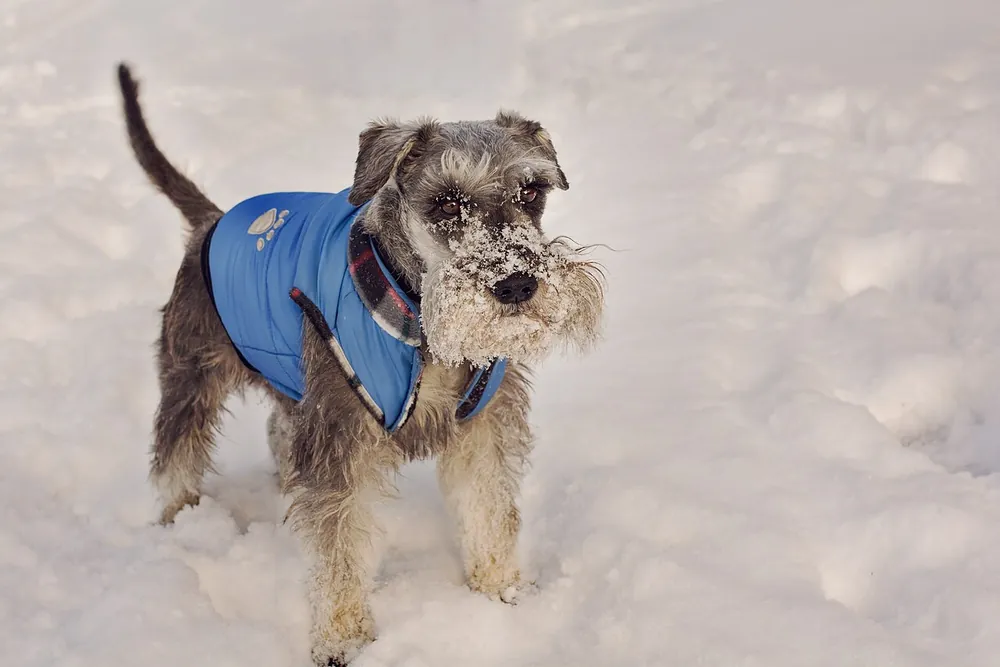
The "to dress or not to dress" argument is pointless, because the answer depends on the dog. For some, clothing is a necessity; for others, it does harm.
Dogs that need it
**Short-coated dogs without an undercoat:** Dobermann, Boxer, Staffordshire, Pointer, German Shorthaired Pointer, Italian Greyhound, Whippet.
**Small dogs:** the smaller the dog, the faster it loses heat — surface area per kilogram is several times greater in a Chihuahua than in a shepherd.
**Hairless breeds:** Chinese Crested, Xoloitzcuintli.
**Puppies and old dogs:** thermoregulation is not yet tuned in one and failing in the other.
**Dogs recovering from illness, surgery or a close clip.**
**Sighthounds of any size:** they carry almost no subcutaneous fat.
Dogs that do not need it — and are harmed by it
**Northern breeds:** Husky, Malamute, Samoyed, Laikas. Their coat is double, and a suit flattens it — the undercoat stops trapping air, which is how it works. Add overheating on an active walk.
**Large flock guardians:** Caucasian and Central Asian Shepherds, Tobet, Newfoundland, Bernese.
**Any healthy dog with a thick undercoat.** If your dog trots happily at −15 °C without lifting its paws or shivering, it is not cold, and clothing only gets in the way.
How to tell a dog is cold
Shivering. Tucked tail and hunched back. Lifting and shaking each paw in turn. Slowing down, heading home, refusing to walk on. In long-coated dogs, ice balls between the toes.
That is not fussiness. That is the signal to go home.
What to choose
**Function, not fashion.** A good coat covers chest, belly and loin, does not tighten the neck and does not restrict movement. The dog must be able to stride out and sit down freely.
**For short-coated dogs in hard frost** — an insulated suit that also covers the legs.
**For wet weather** — a waterproof shell without insulation: wet fur insulates far worse than dry.
Check after the first walk: dry underneath means the fit and insulation are right; a dog damp with sweat means overheating — go lighter.
Paws and road salt
In Almaty and Astana, roads and pavements are treated with de-icing mixes. For paws this is worse than frost: salt burns the pads, and salt licked off the paws irritates the stomach.
Three approaches, from simplest to most reliable:
1. **Wash the paws after every walk** in warm water and dry them, including between the toes. 2. **Protective wax** before going out — a film between pad and chemical. Lasts one walk. 3. **Boots** — the most effective, but they need introducing. Start at home and with one paw, not by pulling on all four before a walk in the cold.
Cracked pads, limping after a walk, or a dog chewing its feet at home are reasons to see a vet rather than apply whatever is in the cupboard.
About Kazakhstan
Our winters differ: Almaty is damp and windy at −5…−15 °C; Astana is dry at −25…−35 °C with a wind that decides everything. Wind matters more than the thermometer: at −10 °C in a strong wind a dog chills faster than at −20 °C in still air.
And the rule for any winter: **walk length matters more than the coat.** Half an hour of brisk movement beats an hour and a half of slow plodding in the warmest suit ever made.