
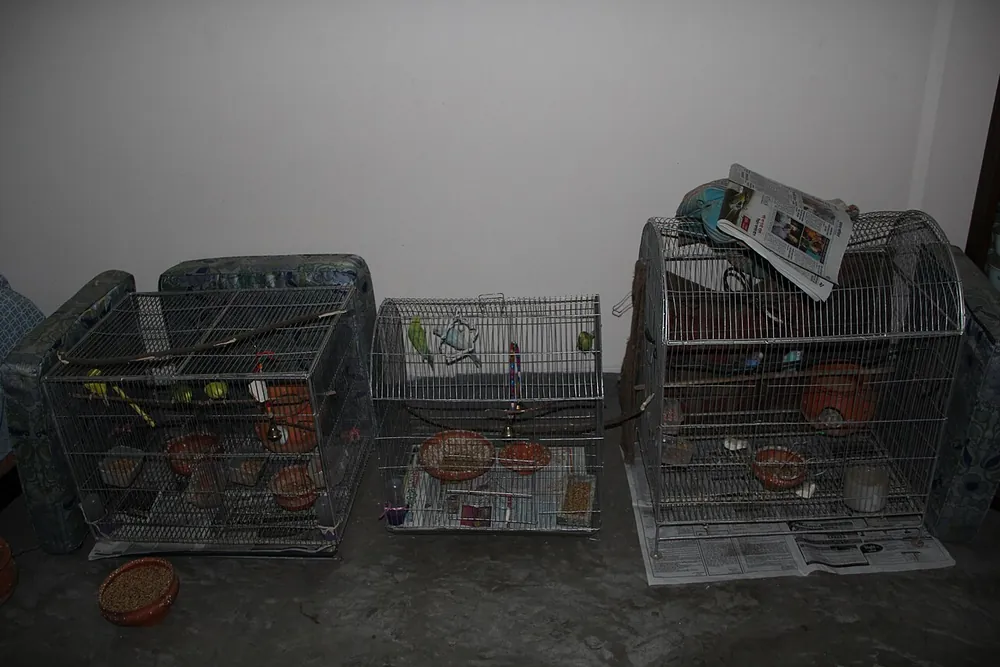
A budgerigar is a bird, not cage decoration. Almost every problem with one comes from three things: too little space, light around the clock, and indoor air that is not what it seems to a human.
The cage
The dimension that matters is width, not height: a budgie flies horizontally, not like a lift.
A guide for one bird is 60 cm wide and upwards — more is better. Bars should be horizontal, because the bird climbs them, and about 1–1.2 cm apart so a head cannot get stuck.
Inside: two or three perches of different thickness made from natural branches (identical plastic perches damage the feet), bowls for food and water, a bath. Remove the mirror: a bird bonds with the reflection and starts feeding it instead of eating.
The base should be a sliding tray lined with paper. Loose sand is not needed.
Stand the cage against a wall rather than in the middle of the room, away from draughts and direct sun. And not in the kitchen.
Flight
A budgie needs to fly every day. This is exercise, not entertainment: without it birds put on weight and fall ill.
Before the first flight: close and curtain the windows (a bird does not understand glass), cover mirrors, cover pans, remove other animals.
Light and sleep
Birds need 10–12 hours of darkness and quiet. A cage under a lamp until midnight is a common cause of screaming, feather plucking and constant breeding behaviour in hens.
The simplest solution is to cover the cage with a cloth at the same time each evening.
Sunlight through window glass gives a bird very little of what it needs for vitamin D. If your bird spends little time in unfiltered light, ask an avian vet about a suitable lamp and about the diet.
Bathing
Most budgies enjoy bathing: a bath in the cage, a shallow dish of water, or a fine mist from a spray bottle. Room-temperature water, no shampoo.
Dangers in the home
**Non-stick cookware.** Overheated, it releases fumes that are lethal to birds: a single burnt pan in the next room can kill a budgie. Birds and kitchens belong in different rooms, full stop.
**Aerosols, air fresheners, scented candles, incense.** A bird's respiratory system works differently; what is "just a smell" to you is poisoning to them.
**Avocado, chocolate, coffee, alcohol, salt.** Never.
**Open water.** A pot, a bucket, a toilet, an aquarium — a bird lands on the edge and drowns.
**An open window without a screen.** A budgie does not survive outdoors.
What to check every day
The bird is active, eating, preening, with well-formed droppings. A bird that sits fluffed up, breathes with effort or with a bobbing tail, sleeps during the day on both feet, or has stopped singing needs an avian vet — preferably today.
Birds hide illness to the last: visible weakness in a parrot means there is no more time to wait.
In Mr. Petman you can keep a profile for a bird and record its weight — in a parrot that is the earliest signal: weight loss is invisible under feathers, but ten grams on the scales are obvious at once.