
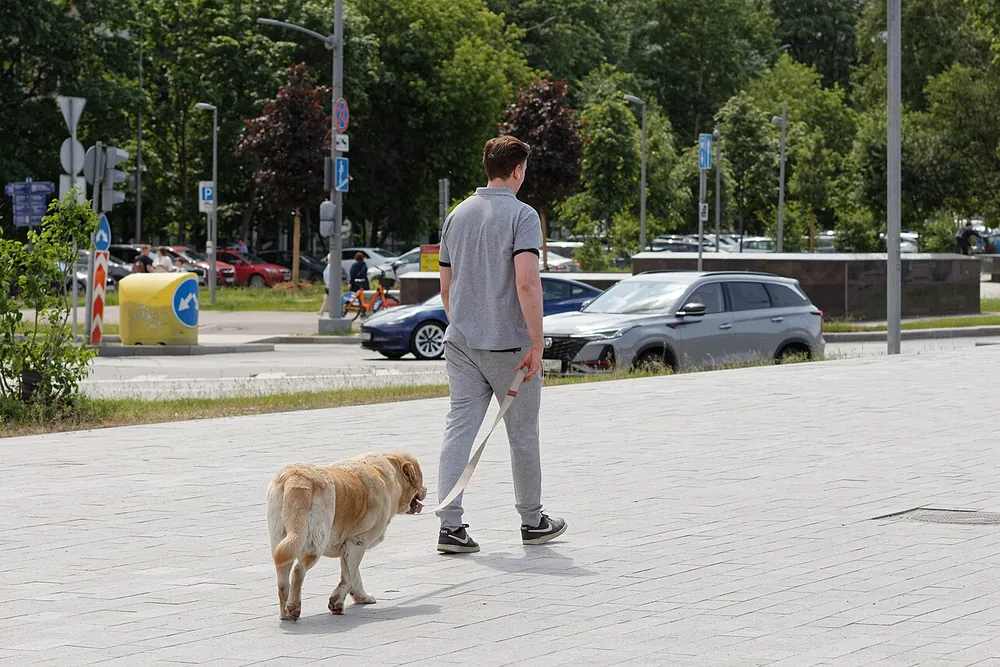
A dog pulls for a simple reason: it works. It pulls and it gets where it wanted to go. Every walk on which a tight lead delivered the dog to its goal reinforces the habit harder than any command.
So what has to change is not the dog but the rule: a tight lead no longer takes you anywhere.
The main technique
The dog pulls — you stop. No jerking, no shouting, you just stand like a post. The lead goes slack, the dog looks back or steps towards you — you walk on. It pulls again — you stand again.
This is boring and very slow. The first walk done this way can take fifteen minutes to cover a hundred metres. That is normal: you are unlearning a habit built over months.
The second technique is changing direction. The dog surges forward, you turn silently and walk the other way. The dog discovers that it is not the one deciding.
Both require one thing: consistency. If you stop for nine pulls out of ten and give in on the tenth because you are late, the dog learns the tenth. Intermittent reinforcement is the most durable thing in learning, and here it works against you.
What does not work
Jerking the lead. The dog gets used to pressure on the neck and pulls harder — that is a reflex, not stubbornness: pressure from the front makes an animal lean into it.
Prong and choke collars. The same thing with pain added. They give a visible result on the first walks and produce a dog that is afraid of the lead and listens worse outdoors overall.
A retractable lead. It is built so that there is always tension — by definition it teaches pulling.
What helps
A harness with a front, chest attachment: pulling turns the dog sideways instead of letting it lean in. It is not a solution, it is a tool that makes training possible.
A fixed lead of one and a half to two metres. Not a retractable one.
Walking after the dog has already burned off its first charge of energy. Five minutes of play in the yard before setting off does more than half an hour of corrective stops.
A treat in the hand on the side the dog walks on. It stays by your leg because that is where the interesting things are, not because it must.
How long it takes
An adult dog that has pulled for two years does not stop in a week. A realistic timeline is one to two months of daily work. The sign that you are on the right track: the share of the walk on a slack lead grows, however slowly.
If the dog is stronger than you and you cannot physically hold it, do not be a hero. That is a job for a trainer, and one or two sessions in person save months. Watch the method: a specialist who starts with "put a prong collar on" is solving your problem at the dog's expense.