
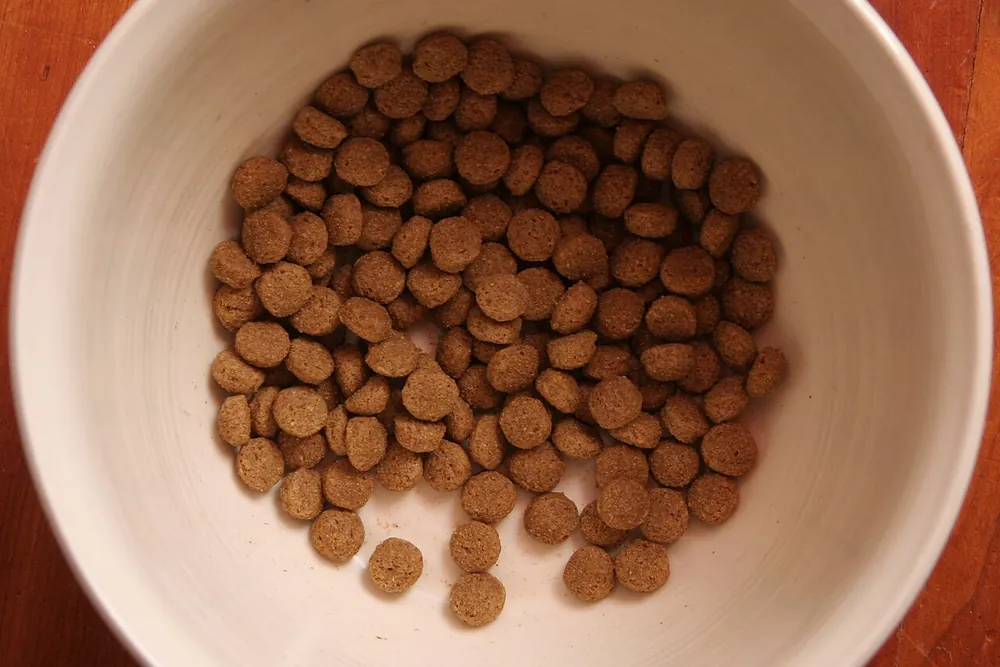
The bag gives a daily amount in grams by body weight. That is a starting point, not an answer: the manufacturer does not know your dog's age, whether it is neutered, or how much it moves. Two twenty-kilogram dogs — a young active labrador and an older neutered bitch who walks for half an hour — can differ in requirement by half as much again.
What the calculation is based on
First comes the resting requirement: the energy needed simply to exist — to breathe, hold temperature, keep organs working. It scales non-linearly with body mass, which is why a small dog needs noticeably more per kilogram than a large one.
That figure is then multiplied by a factor: growing puppy, neutered adult, active adult, senior, dog on a weight-loss plan — each has its own. The resulting kilocalories are divided by the energy density of your particular food, and that gives grams.
Our calculator does this arithmetic: it asks for species, age, weight, neutering, activity and the energy density of your food, and returns grams per day and per meal. Working it out by hand is worth doing exactly once — to understand where the number comes from.
Which weight to use
The current one, if the dog is in shape. If the dog is overweight, calculate from the target weight rather than the current one, otherwise you are feeding the dog you are trying to stop feeding.
In shape means: ribs are felt under the skin without pressing, but do not stick out; a waist is visible from above; the belly tucks up from the side. Scales help, but hands are more honest — the same number means different things on different frames.
How many meals
Puppies under four months: four times a day. Up to six months: three. After that, two. Adults: twice, morning and evening. Once a day is acceptable but two is better — a smaller load per meal and less begging.
Weigh it, do not scoop it
Cups and scoops lie: the same volume of different kibble varies in mass by tens of percent. Kitchen scales are cheap and settle the question permanently.
Treats are food too. Everything given outside the bowl should fit within roughly a tenth of the daily allowance, and the meal is reduced by that same amount. Training on cheese on top of a full bowl is the most common reason a dog gains weight on "correct" feeding.
How to check
Weigh the dog monthly and write it down. One figure means nothing; a line over six months shows whether you got the amount right. If the weight creeps up, cut the portion by about a tenth and watch for another month.
When switching foods, change gradually over a week, mixing new into old: an abrupt change almost always upsets digestion.