
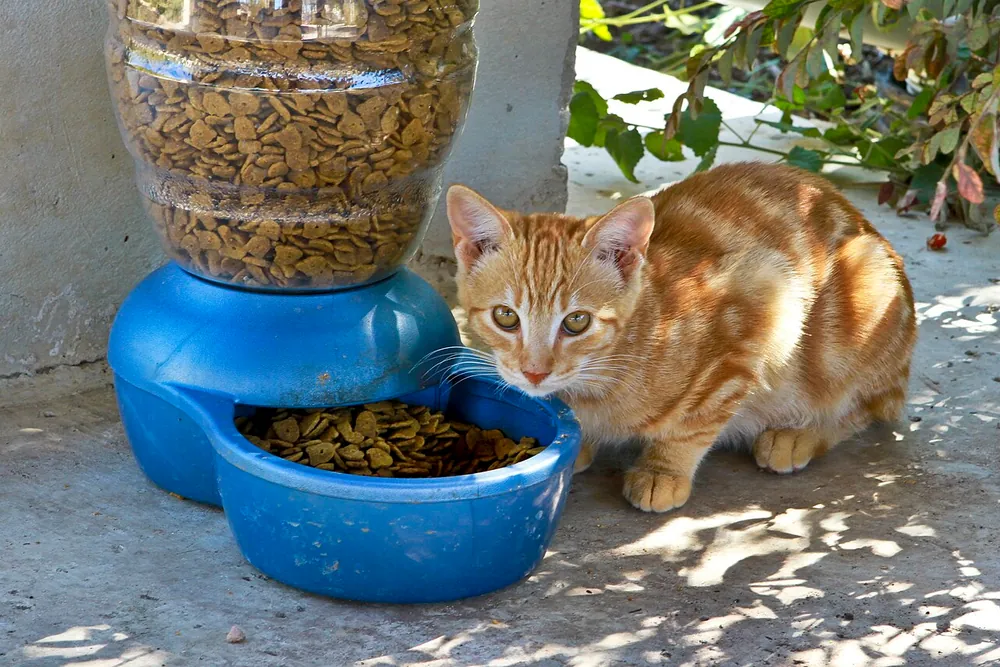
The short answer: enough to keep the weight where it should be. Everything else is a way of getting closer to that, and the table on the bag is the worst of them.
Why the bag cannot be trusted
Manufacturers quote figures for an averaged cat: not neutered, middle-aged, moderately active. Few such cats exist.
There is a simpler reason too: it suits the manufacturer for the bag to empty faster. Feeding guides are systematically generous, and it shows on the scales within six months.
How it is actually calculated
First the **resting energy requirement** — what the cat spends simply existing:
> 70 × (weight in kg to the power of 0.75)
For a 4 kg cat that is about 198 kcal a day.
Then multiply by a factor:
| Cat | Factor | |---|---| | Neutered adult | 1.2 | | Entire adult | 1.4 | | Prone to weight gain | 1.0 | | Weight loss | 0.8 of the target weight figure | | Kitten under 4 months | 2.5 | | Kitten 4–12 months | 2.0 | | Pregnant, nursing | 2.0 and above |
A neutered 4 kg cat comes out around 240 kcal a day — usually less than the bag suggests for that weight.
From calories to grams
Next you need the energy density of your food, printed on the bag in kcal per kilogram or per 100 g.
Dry food is usually 3500–4000 kcal/kg. At 3800, 240 kcal means **about 63 grams a day**.
Wet food is roughly four times less dense because it is mostly water: 70–100 kcal in an 85 g pouch. The same 240 kcal is **about three pouches**.
Mixed feeding is calculated in calories, not grams: "half a portion of dry plus half a tin" is not half the ration.
What to measure with
Not a measuring cup but **kitchen scales**. A cup varies by up to a third depending on how it was filled, and a third of the ration is exactly the difference between a normal cat and an overweight one.
How many meals
Two or three for an adult. Cats naturally eat little and often, so split meals suit them better than one large bowl.
Free feeding works only for active, entire cats. In neutered cats it almost always ends in excess weight.
How to tell the amount is right
By the cat, not the bowl. Every two weeks: ribs felt under the skin without pressing, waist visible from above, belly not hanging. Weigh monthly and record it — a chart shows gain months before the eye does.
If the weight moves, change the portion by 10% and wait two weeks rather than halving it at once.
When calculating is pointless
In kidney disease, diabetes, pancreatitis or after surgery, the diet and the amount are set by a vet. Therapeutic diets are calculated differently, and improvisation does harm.
In Mr. Petman the calculation uses weight, age, neutering and activity, then converts to grams of your specific food from the catalogue.
This article is a guide, not a prescription. The ration for a particular cat — especially an ill one — is set by a vet.