
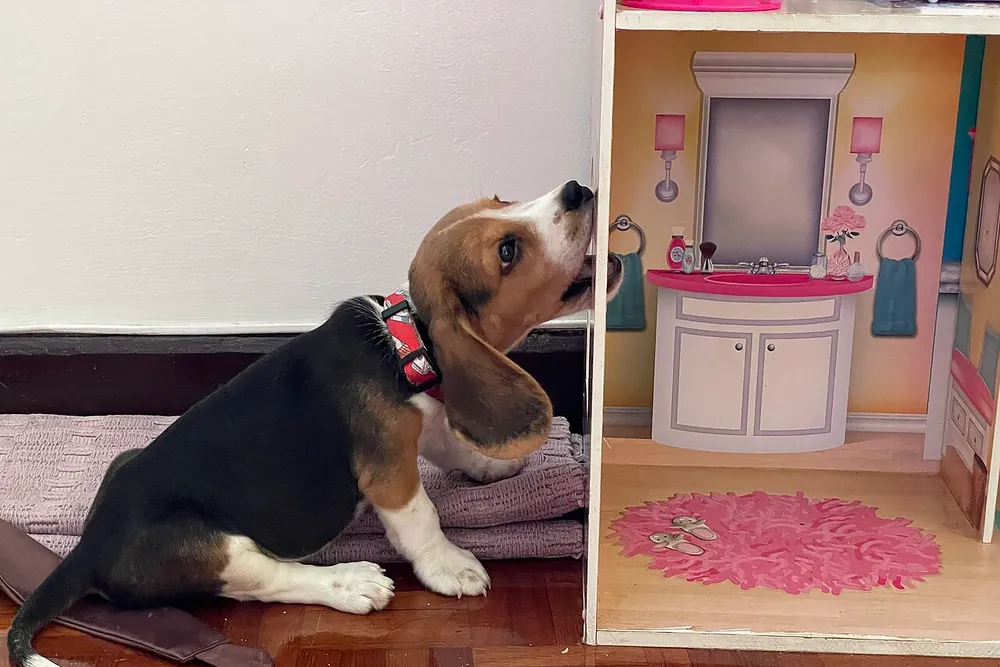
A puppy that chews furniture, shoes and your fingers is a normal puppy. It explores the world with its mouth the way a child does with its hands. And from roughly three or four months to six or seven months its teeth are changing: the gums itch, and chewing is the only way to ease it. The task is not to forbid it but to redirect it.
Why it does this
Teething. It peaks at around four to six months. This is when a puppy chews the most, and you may see small spots of blood from the gums on its toys — that is normal.
Boredom. A puppy needs not only walks but also something for its brain to do. Without an activity it will find one itself.
Attention. If a chewed slipper earns a chase around the flat, the puppy quickly learns how to start a fun game.
What to do
Put away anything valuable or dangerous: shoes, cables, remote controls, medicines, small objects. Cables go into covers or behind furniture: a chewed live cable is dangerous.
Give it things it is allowed to chew: chew toys of different hardness — rubber, rope, the kind you fill with food. Rotate them every other day so they stay interesting. A toy from the freezer soothes the gums while teeth are changing.
Swap, do not snatch. The puppy grabbed a slipper — offer a toy, and when it switches, praise it. A slipper taken away with nothing in return tells the puppy the slipper is very valuable.
Hands are not toys. If the puppy nips your hand in play, say a short "ouch", stop the game and turn away for a few seconds. This teaches it that teeth on skin end the fun.
Work its brain. Ten minutes of training or hunting for food hidden around the flat tires a puppy more than half an hour of running around.
When you cannot supervise, use a pen or a room with nothing valuable in it. This is not a punishment but a safe place with nothing to destroy.
What not to do
Do not punish after the fact. The puppy does not connect your shouting with the slipper it chewed an hour ago — it connects it with you coming home. Do not hit it or push its nose into the damage: that teaches it to fear you, not to leave things alone.
When it is no longer about age
If a dog over a year old chews things mainly when it is left alone, this is more often separation anxiety than play. We have a separate article about it.
If a dog chews and swallows things that are not food — stones, fabric, plastic — take it to a vet: a swallowed object can get stuck. And if vomiting, refusing food or lethargy follow, see a vet the same day.