
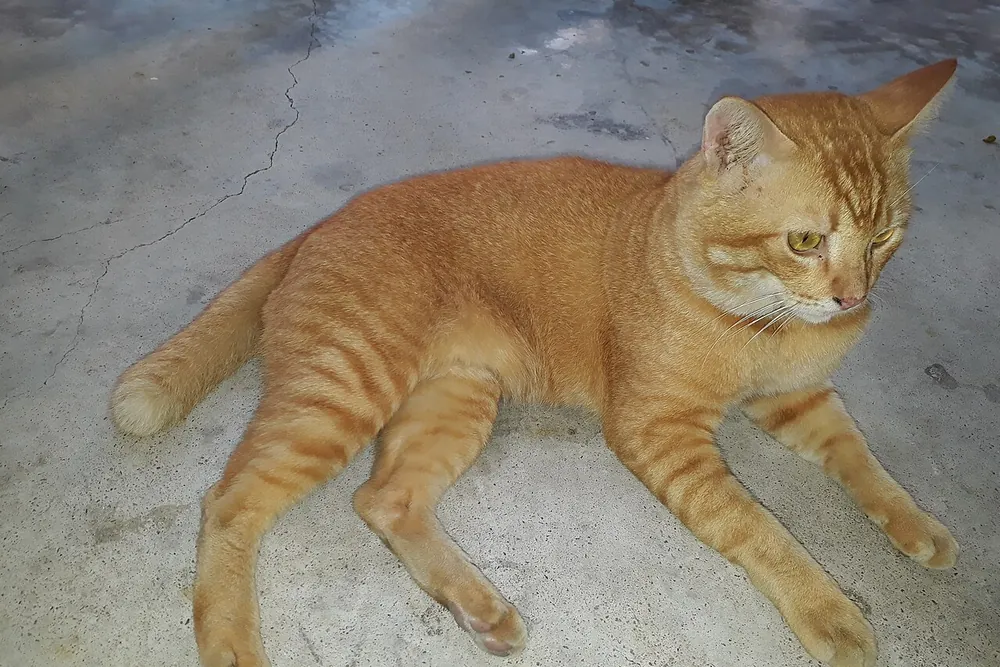
Animals do not show pain the way people do. That is not stoicism but inheritance: in the wild, whoever limps most visibly is taken first. So a cat in severe pain simply sits in a corner, and a dog still wags its tail at the door.
Here is where pain does show.
Cats
**Hiding.** A healthy cat sleeps in plain sight. A cat in pain goes under the bed, into a wardrobe, behind the toilet.
**Stops jumping.** No longer leaps onto the windowsill it used to fly at; comes off the sofa sideways and slowly.
**Grooming changes.** Either it licks one spot bald — where it hurts — or stops grooming altogether and the coat turns unkempt.
**Posture changes.** Sits hunched with paws tucked and head low. With abdominal pain it will not lie on its side.
**The face.** Vets use a grimace scale: squinted eyes, ears rotated outwards and slightly back, a tense, elongated muzzle, whiskers pushed forward. Individually these mean nothing; together they do.
**Litter tray changes.** A cat with back or joint pain may stop climbing into a high-sided tray.
Dogs
**Changed resting posture.** Does not lie down the usual way, rises slowly, shifts around before settling.
**Limping or favouring a leg** — the most obvious sign, but not the only one.
**The "praying position"** — front legs and chest on the floor, rear raised — with severe abdominal pain. That means driving to a clinic now.
**Trembling without cold, fast breathing at rest, drooling.**
**Snapping when touched** where touch used to be fine. A dog that has suddenly turned "nasty" is usually hurting, not spoiled.
**Stops playing, greeting, asking for walks.** A quiet dog is not always a well-behaved one.
Common to both
Changed appetite. Changed sleep. Withdrawal — or the opposite, insistent demands for attention. Fast breathing at rest. **Any sudden change in behaviour** is a signal until proven otherwise.
You know your animal better than any vet does. "He is somehow not himself" is a legitimate reason to be seen, and vets take it seriously.
What never to give
**Paracetamol** is lethal to cats — one tablet kills. It is dangerous to dogs too.
**Ibuprofen, aspirin, metamizole, nimesulide** cause stomach ulcers and kidney damage in both species.
**Painkillers "left over from last time"** or from another animal: the dose depends on weight and condition, and the old diagnosis does not repeat itself automatically.
The rule is simple: **there is nothing in a household medicine cabinet that you can give an animal for pain.** Pain relief for cats and dogs exists, works well, and is prescribed by a vet.
When to go immediately
Do not wait for morning if:
- the praying position, a hard distended belly, unproductive retching — this can be gastric torsion, and the clock runs in hours; - a male cat cannot urinate, sits in the tray and cries — urethral blockage kills within a day; - breathing is fast and laboured, tongue and gums bluish or pale; - crying out on touch, refusing to move; - injury, a fall from height, hit by a car — even if the animal looks intact.
Before the appointment
Write down when it started, what changed, what the animal ate, and if you can, take a short video — limping and posture often "disappear" at the clinic from stress, but the vet can watch the video.
Withhold food if you suspect abdominal pain: anaesthesia may be needed.
In Mr. Petman you can note a symptom in the pet's profile with the date. Every vet asks when it started, and an exact answer often matters more than the description.
This article is about observation, not diagnosis. What hurts and how to treat it is determined by a vet on examination.