
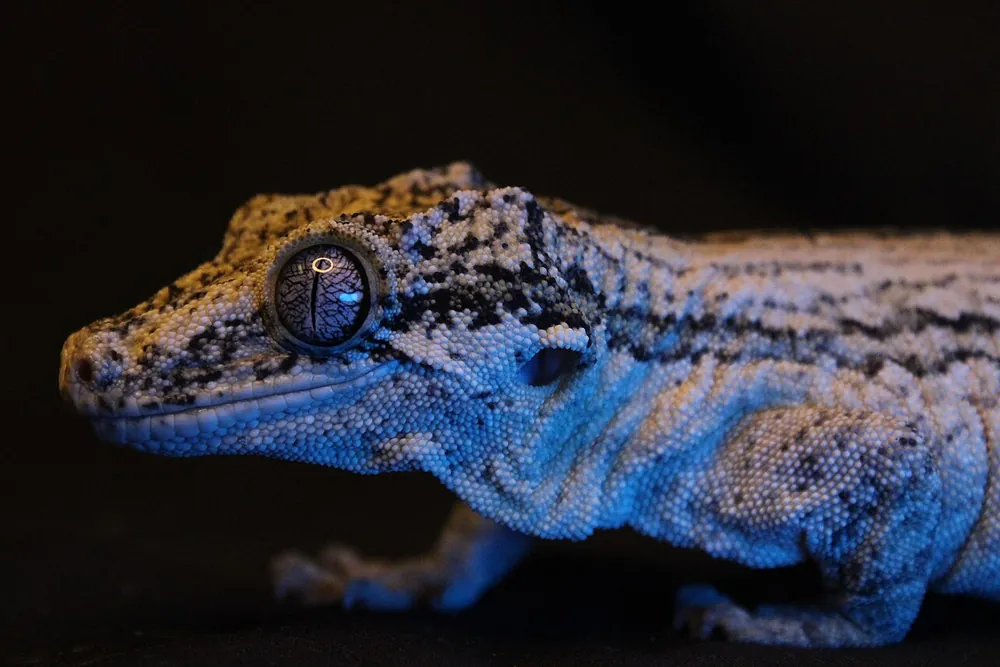
The leopard gecko is usually a household's first lizard. It is calm, does not need an enormous enclosure and lives fifteen to twenty years. It has one difficulty, and it is an important one: a reptile does not warm itself, and its health rests on temperature and on calcium.
The enclosure
For one adult, a horizontal enclosure from 60 cm long and upwards. Height hardly matters: this gecko does not climb walls the way others do.
Two males cannot be kept together — they will fight. Females are sometimes kept in groups, but a single animal is simpler and safer for a beginner.
A lid is essential — against escapes and against the cat.
Heat comes first
A gecko needs a gradient: a warm end and a cool end, so it can choose where to be.
The figures most often quoted: a warm zone around 30–32 °C, a cool side around 24–25 °C, cooler at night. Confirm the exact regime for your animal with an exotics vet or the breeder — it depends on age and condition.
Heat comes from below (a mat under the base) or from a lamp. **A thermostat is mandatory**: without one a mat overheats the floor, and that is the most common way geckos get burned.
Put a thermometer at both ends — heat cannot be judged by hand. Do not use hot rocks: they cause localised burns.
Hides and humidity
There should be at least three hides: one warm, one cool and one humid — a box with damp moss or coconut substrate.
The humid hide is not decoration: without it a gecko sheds badly, and retained skin tightens around toes and tail. Dried skin on the toes leads to losing them.
Substrate
For a beginner, paper towel, tile or a reptile mat is easiest. Fine sand is risky for young geckos: they swallow it along with their food.
Food
Leopard geckos are insectivores. The staples are crickets and roaches; superworms and mealworms are extras, being fatty.
There is no fruit, vegetable or cat food in their diet.
Juveniles are fed more often, adults less — commonly every other day or so; the exact schedule depends on age and condition.
**Calcium is a requirement, not a supplement.** Insects are dusted with calcium powder, and vitamin D3 is given on a schedule set by your vet or breeder, depending on whether the enclosure has a UV source. Without calcium, reptiles develop metabolic bone disease: limbs bend and the jaw softens. It develops quietly and shows late.
A small dish of calcium in the enclosure is standard practice.
Feed the insects themselves before offering them (this is called gut loading): a starved cricket has almost no nutritional value.
Shallow water must always be available.
Common mistakes
A heat lamp with no thermostat and no thermometer. Sand under a young gecko. No humid hide. Feeding mealworms alone. Grabbing the tail: a frightened gecko drops it, and the regrown one is never the same.
When to see a vet
The gecko has not eaten for a week and is losing weight; the tail has become thin; the legs tremble or give way; shed skin is stuck on the toes; there is an open burn on the belly.
You need a vet who treats exotics — find one in advance. In Mr. Petman you can keep a profile for a reptile and record weights and sheds: in a lizard, weight and tail are the two most honest indicators of how things are going.